

I spent fourteen years as a hairdresser before I ever sat on a scooter.
Then I moved to Bali, started riding every day, and that's when I started seeing it.
Every week, someone in my chair with snapped ends, thinning temples, or that halo of short broken hairs above the forehead that nobody can explain. I got good at spotting where it came from.

That's what this guide is. Not a list of tips scraped off other blogs. What actually happens to hair inside a helmet, why, and what genuinely reduces it. Some of it will save you real damage. Some of the things you've been told don't work, and I'll say so.
What helmet hair actually is
Helmet hair gets treated like a styling problem. It isn't. It's three separate physical processes happening at once, and they need different solutions.
1. Friction
Every strand of your hair is wrapped in a layer called the cuticle. Microscopic overlapping scales, a bit like roof tiles. When they lie flat, hair looks smooth and reflects light evenly. That's what shine actually is.
Rub those scales repeatedly against the inside of a helmet and they start to lift.
Lifted cuticles mean rougher texture, faster tangling, moisture escaping more easily, and less shine. And once the surface is rough, strands stop sliding past each other and start catching instead.
The chain looks like this:
Friction → cuticle lift → tangling → brushing force → breakage

Frizz is just the visible part. It's a symptom, not the problem.
2. Compression
A well-fitted helmet sits firmly against your head. That's the whole point - a loose helmet is a dangerous helmet.
But sustained pressure flattens hair at the root and holds it there. On a short ride that's cosmetic and it drops out within the hour. On a long one, combined with heat and sweat, hair effectively sets in that position.
Compression is the one people complain about most and it's the least damaging of the three. It's temporary.
3. Heat and moisture
This is the one nobody talks about, and it's the one that does the quiet long-term damage.
Helmets trap heat. Your scalp responds by producing more oil. Sweat has nowhere to go, so it sits against the scalp and the hairline for the length of your ride.
Warm, damp hair also behaves differently. It's softer, more elastic, and far more willing to stretch out of shape and stay there. Which matters enormously for the next part.
Before the ride
Most riders think about helmet hair after the helmet comes off. By then you're managing damage that's already happened.
The state your hair goes in determines most of what comes out. Dry, rough hair tangles faster. Loose hair whips and wraps. Product buildup sits against the lining and grabs.
Four things, none of which take long.
Don't ride on soaking wet hair
If you take one thing from this guide, take this one.
Wet hair is at its most fragile. It can stretch roughly 30% further than dry hair before it breaks, and it doesn't reliably spring back to its original structure. Put a helmet on it and you've combined maximum stretchiness with friction and compression, all at once.
If you've just washed it and you have to ride, dry it as much as you can first. If there's no time, braid it damp and let it dry in the braid rather than loose against the lining.
Put something on it first
A small amount of lightweight oil or leave-in conditioner through the mid-lengths and ends, before the helmet goes on.
It coats the hair shaft and gives friction something to slide against that isn't your cuticle. Not much. Just enough to smooth, not enough to make hair greasy against the lining, which causes its own problems.
Think of it the way you think about SPF. You don't wait until after the sunburn.
Secure it properly, and think about what you're securing it with
Most riders throw their hair up in about four seconds before setting off. It feels practical. It's where a lot of the damage starts.
The rule that covers almost every situation: nothing hard, knotted, or bulky anywhere the helmet presses.
That means no low messy bun, no clips and definitely no claw under the shell. Anything with structure becomes a pressure point with the full weight of the helmet behind it, and that's exactly where you'll find breakage in six months.
What works instead:
- A low braid, or two, sitting at or below the nape
- A low, loose ponytail secured below helmet level
- Nothing at all, if your hair is short enough to stay put

And the tie matters more than people think. Anything with a metal join is a snag waiting to happen. Ask yourself before you fasten it: is this going to pull hair out when I take it down? If the answer is maybe, use something else.
Put the silk layer in
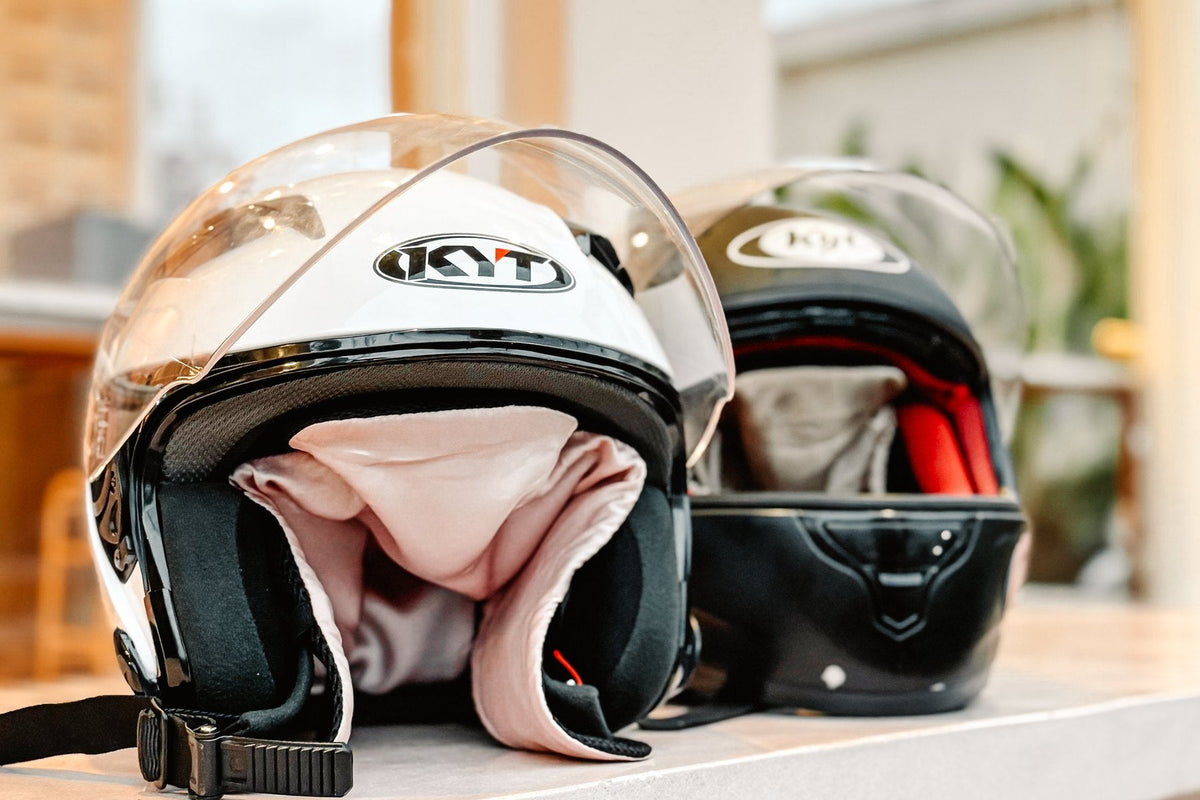
The lining inside most helmets is a textured synthetic, chosen for durability and moisture-wicking. Nobody designing it was thinking about your hair.

A smooth layer between your hair and that lining removes the friction at source, which is the only point in the chain where you can actually stop it. More on where this genuinely helps and where it doesn't further down.
During the ride
Less in your control here, but two things are worth knowing.
Fit matters, and not in the direction people assume. A helmet that's slightly too big moves. Movement is friction, repeated for the entire ride. A correctly fitted helmet sits still, and a still helmet does less damage than a loose one, as well as being the only one that will protect your head. Never loosen a helmet for your hair.
Use your vents. Open vents mean less trapped heat, less sweat, and less of that soft-and-stretchy state where hair damages most easily. On a hot day this is a genuine difference, not a marginal one.
Taking the helmet off
Here's where more damage happens than in the entire ride before it, and almost nobody thinks about it.
The usual method is unclip, pull straight up, done. It takes two seconds and feels completely harmless.
But the padding has to travel across your hairline, over the crown, and down past the nape to get off your head. That's a hard drag across the three most fragile areas you have. And if you've just been riding, your hair is warm and damp and at its stretchiest.

Snapped baby hairs at the front. Breakage at the crown. Those short new-growth-looking hairs above your forehead that never seem to get longer. A lot of that is removal, not riding.
The ten-second version
- Fully unfasten first. Check nothing is caught in the buckle before you start lifting.
- Widen it. Pull the chin straps out and away from your face so the shell opens rather than grips.
- Go slower than feels necessary. Speed creates drag. Slow creates glide. This is the whole technique.
- Lift the helmet up and back. lifting up slightly then back moves the padding with your hair rather than against it.
- Finger-check before anything else. Run your fingers through the ends and the nape. If you feel resistance, that's a tangle, deal with it before a brush goes anywhere near.
After the ride
What you do in the next five minutes decides whether the ride cost you anything.
Let your scalp breathe first
Don't immediately tie it back up. A few minutes of air lets heat and moisture escape instead of sitting trapped against the scalp for another hour.
Brush it properly, which most people were never taught
Brushing from the roots down gathers every tangle into one dense knot and then forces the brush through it. That's not detangling, that's tearing.
- Start at the ends. Always.
- Work in small sections
- Move gradually upward
- Only brush root to tip once the whole length runs clear
Use a wide-tooth comb or a brush with genuinely flexible bristles. Something that gives when it meets resistance rather than dragging through. If your hair is prone to tangling, a detangling spray is worth the ten seconds.
And if it's still damp from sweat, treat it as wet hair. Same fragility, same rules.
Getting the volume back
For flattened roots: tip your head upside down, shake gently at the roots, and let it fall back. Cool air from a dryer does more than hot. Dry shampoo helps with oil at the roots, but it will not fix compression, and using it as a daily fix creates buildup that makes the next ride worse.
By hair type
Fine hair. Compression is your main issue - it flattens fastest and takes longest to recover. Keep product light and off the roots entirely. Fine hair also breaks at lower force, so the brushing method matters more for you than anyone.
Thick hair. Friction and heat. There's more surface area rubbing and more trapped warmth. Braiding before the helmet, rather than tying, makes the biggest difference here.
Curly and textured hair. A different problem entirely - the helmet disrupts the curl clump itself, and once curls are broken apart they frizz rather than flatten. Protective styling beforehand matters far more than anything you do afterwards. This one deserves its own guide and it's coming.
Short hair. Least breakage risk, most visible compression. Prep barely matters. Post-ride reset is everything.
Colour-treated or bleached hair. The cuticle is already lifted before the helmet goes anywhere near it, so every process above hits harder and faster. If you colour and you ride daily, prevention isn't optional.
What doesn't work
Things I see recommended constantly that don't hold up:
Loosening your helmet. It increases movement, increases friction, and compromises the one job the helmet has. Never.
Dry shampoo as the whole strategy. It manages oil. It does nothing for friction, breakage, or compression, and daily use leaves buildup that makes friction worse.
Tying it tighter so it moves less. Tension plus pressure at the same point is how you get traction damage at the hairline. Secure, not tight.
Repair products as prevention. Masks, oils and bonding treatments are useful, but they work on damage that's already happened. Once a cuticle has been repeatedly roughed up, no product truly reverses that structural change. You can improve how it behaves. You can't undo it.
Which is the honest summary of this entire guide: prevention beats repair, every time, and it isn't close.
Where a silk insert fits
This is what I make, so take it with that in mind, but I'd rather be straight with you than sell you something that won't help.
A silk insert is a smooth layer between your hair and the helmet lining. Silk has a naturally low friction coefficient, which in plain terms means hair slides across it instead of catching. It removes the friction at the point it starts, which is the only place in that chain you can intervene.

It's the same principle as a silk pillowcase, applied to the thing your head spends real time inside.
What it does: reduces friction during the ride and during removal, cuts tangling, and means less force needed when you brush afterwards.
What it doesn't do: It won't stop compression. Nothing will, short of not wearing a helmet. It won't fix damage you already have.
If you ride a few times a year, honestly, the prep and removal habits above will do most of the work on their own. If you ride most days, friction is accumulating whether you can see it yet or not, and that's when a permanent layer earns its place.
We make a slim fit insert that suits most helmets, and a padded version that adds a little structure - useful for open-face styles, or if your helmet has loosened with age. Both are 100% pure silk, not satin, which matters more than the marketing on most products would suggest. If you're not sure yours will fit, we have a page for that.
Frequently asked
Does wearing a helmet cause hair loss?
Not in the way most people fear. A helmet doesn't cause pattern hair loss, which is hormonal and genetic. What it can cause is breakage that looks like thinning, and traction damage at the hairline if you're constantly wearing tight styles under it. Those are different problems with different fixes. If you're genuinely worried about losing hair rather than breaking it, see a professional.
Should I wear my hair up or down?
Down is fine only if it's not long enough to tie up. On anything longer, secured is better than loose. Loose hair whips, wraps, and tangles far more. Just secure it low, below where the helmet sits.
Is a silk insert the same as a skull cap?
No, and the difference matters. Most skull caps are cotton or synthetic and designed for sweat management or warmth. They handle moisture; they don't reduce friction, and some textured ones increase it. Different job.
Can I ride with wet hair if I'm in a hurry?
If you must, braid it first. Wet hair loose under a helmet is the worst combination in this guide.
How often should I wash my hair if I ride every day?
Depends on your hair and your climate, but after a long hot ride a gentle wash removes the sweat and buildup before it sits. Don't over-strip it with harsh shampoo, that creates a separate problem. Daily riding in heat usually means washing more often than you would otherwise, with something gentler than you would otherwise.
Will a looser helmet cause less damage?
No, more. A loose helmet moves, and movement is friction. It's also unsafe. This isn't a trade-off worth making.
My hair is very short. Do I need to worry?
Much less. Short hair has less length to tangle and less to snag on removal. You'll get compression and flat spots, but the breakage risk is genuinely low.
Does any of this apply to cycling or ski helmets?
All of it. The mechanisms are identical: friction, compression, trapped heat. Ski helmets add cold dry air on top, which makes hair more brittle to begin with.
The short version
Helmet hair isn't bad luck and it isn't the price of riding. It's mechanical stress, and mechanical stress can be reduced.
Don't ride on soaking wet hair. Put something on it first. Secure it low, nothing bulky where the helmet presses. Take the helmet off slowly, lifting up and back rather than dragging it straight off. Brush from the ends. And reduce the friction at source rather than fighting the aftermath.
You don't need to stop riding. You just need to stop dragging.
If you want the deeper version of why silk specifically, I've written about the science behind it here. And if you're not sure whether what you're seeing is damage at all, this one on what healthy hair actually means is a good place to start.